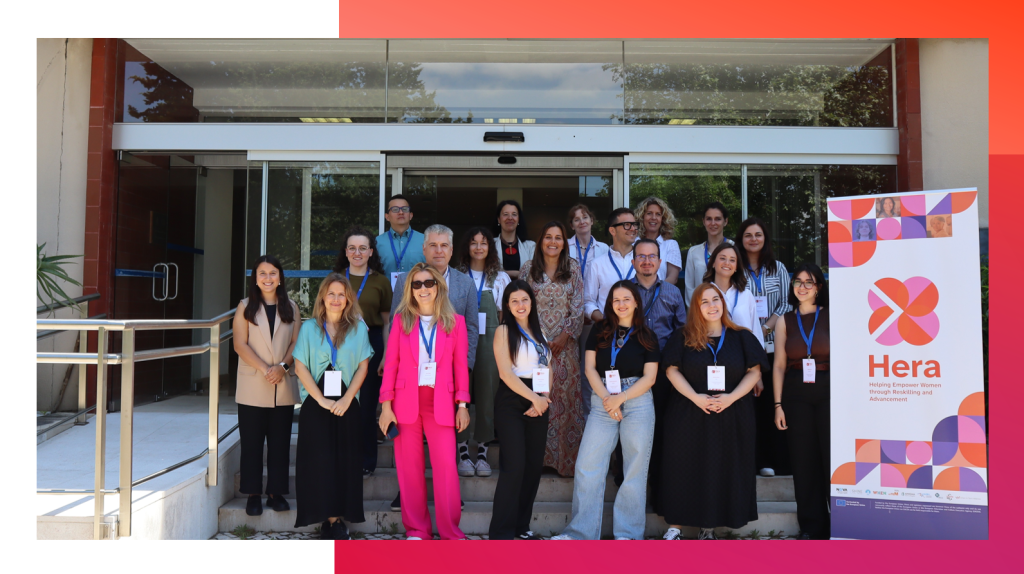
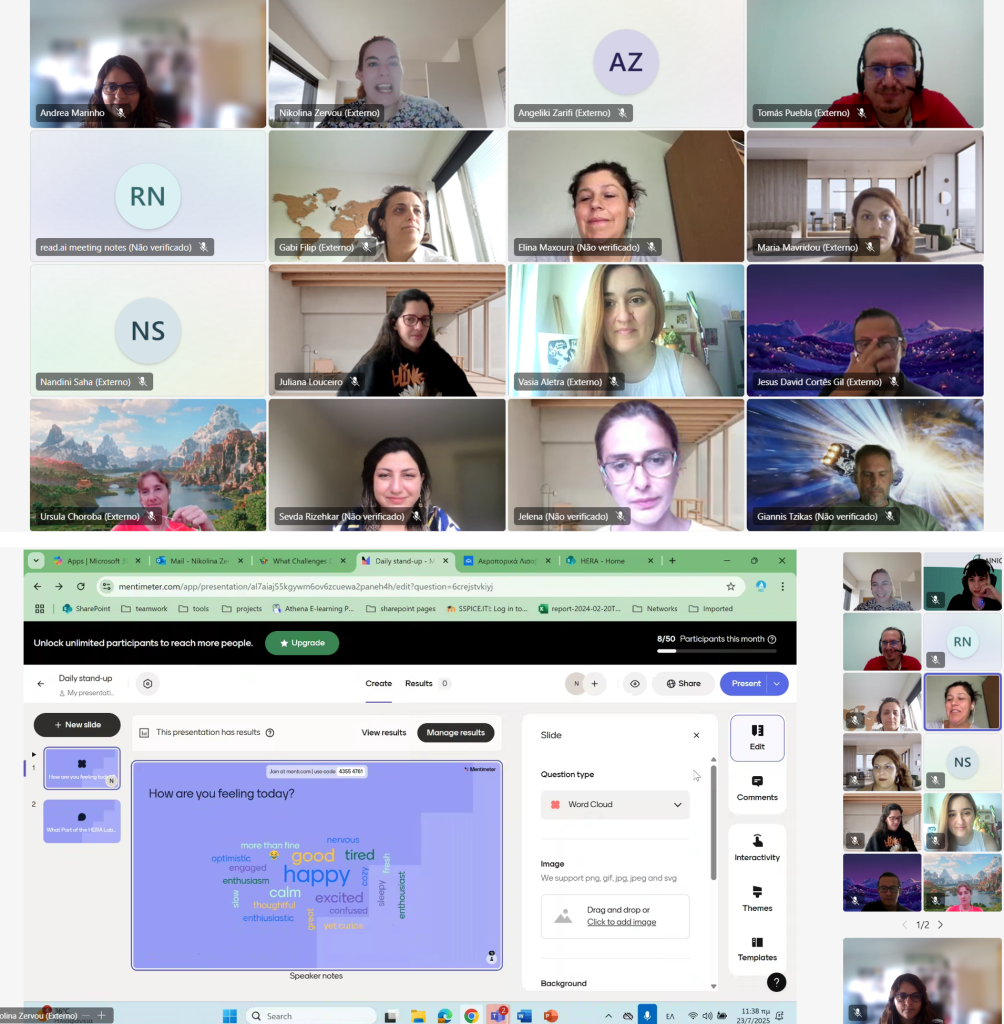
On 23 July 2025, the HERA project partners met online for a training workshop with the HERA facilitators, marking a significant milestone on the path to empowering women 45+ through reskilling and lifelong learning.
The coordinator, NOVA University in Portugal, provided an overview of the HERA project. Therefore, by increasing the participation of women 45+ in adult education, HERA aims to provide them with the right skills to face the challenges of the current labour market and contribute to a more inclusive and equitable society.
Thus, the project methodology of HERA Labs is focused on reskilling, continuous learning, and personal development for women aged 45+. The goal is to create inclusive learning spaces, designed to empower women to reconnect with their skills, involving local stakeholders to ensure relevance and real-life impact. The implementation of the HERA Labs will be an approach that will join the methodologies of mutual aid groups, innovation hubs and living labs.
For this purpose, the Learning to Learn (L2L) training will encourage women to learn more about their learning styles according to preferences and objectives, gain skills related to time management and much more. The HERA facilitators will, with the training tools developed by the consortium, learn about how to motivate, guide and encourage women aged 45+ in their learning process. The course will consist of five modules.
The HERA Community Platform will transfer the real-life settings into a digital environment, based on AI technology to simulate all the processes and tools of the HERA Labs in the digital context. The platform will provide cooperation and guidance on the educational journey, by using an AI-Engine to match the user´s training needs and wishes to available online content. The HERA Community Portal will be available in the consortium languages.
With that in mind, the HERA impact measurement methodology consists, namely, of a participant recruitment protocol and strategy, where inclusivity, motivation and ethical standards are important. A quantitative survey to consider the different cultural and socio-economic environments and a qualitative complement to the surveys through facilitators insights (case studies), will also be used. This impact assessment will verify the effectiveness of the HERA approach.
Stay tuned for more updates on this inspiring project that seeks to improve the lives of women 45+ by providing them with the right skills for future jobs, addressing labour and gender gaps.